


One of the biggest misconceptions surrounding ventilation is that it signals the final stage of a neuromuscular disease.
This isn’t true.

Nazmin Shah
“Respiratory interventions are intended to improve symptom management, reduce respiratory complications, enhance life, and, in many cases, prolong overall health,” says Nazmin Shah, a respiratory therapist at a teaching institution in San Francisco.
Experts view respiratory support as a proactive strategy for protecting long-term health that can be started at any point in the disease course where it is appropriate.
For many people living with neuromuscular diseases and their families, that shift in perspective is important.
Community members who are using breathing devices back that up. They credit their ventilators and other respiratory equipment with enabling freedom and mobility in their homes and on the go — and with giving them the energy to enjoy it.
Lacey’s experience: Heed the warning signs
Lacey Woods was diagnosed with limb-girdle muscular dystrophy (LGMD) as a teenager. The weakness in her limbs progressed gradually, and she eventually began using a power wheelchair. Then, in middle age, weakening respiratory muscles caught up with her.
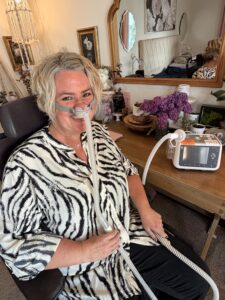
Lacey Woods using her BiPAP machine
“It was so subtle that I didn’t notice anything except that I was going to bed a little bit earlier than normal, and I was breathing a little bit more frequently when I was having a conversation,” she says.
But there were other signs of respiratory weakness that she didn’t recognize at the time: low energy, low appetite, and depression.
“I was emotionally run down,” she says.
Yet when her pulmonologist suggested she use a bilevel positive airway pressure (BiPAP) machine at night, she didn’t feel ready for a new device in her life. “I pushed it off as far as I possibly could,” she says.
Her respiratory therapist helped her understand why she needed the BiPAP and encouraged her to adopt it gradually.
“He told me to sit with it while I was watching TV or working, just to start getting used to it,” she says. “At night, when I would lie down, it would still feel like too much pressure. But the more I could relax, do a little bit of meditation, the more my body got used to it.”
Once she was using the BiPAP consistently at night, she noticed a big difference. “I didn’t wake up with a headache; I woke up with energy,” she says. “I still do. I’m not run down, I can think clearly, and I have an appetite again.”
Even though Lacey now loves her BiPAP, she knows the emotional barriers to ventilation are real. “It’s important to grieve a new phase of your disease and give yourself that time — but don’t wait too long,” she says.
Jonathan’s experience: A change for the better
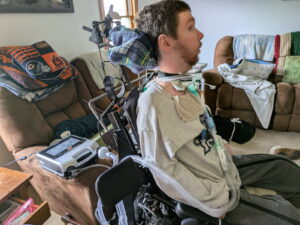
Jonathan Blaser using his ventilator
Jonathan Blaser, 36, was diagnosed with Duchenne muscular dystrophy (DMD) at 2 years old. As a teenager, he began using a cough assist machine to help clear his airways and a VPAP (a type of BiPAP machine) at night. As his symptoms progressed, he needed full-time ventilation.
In 2009, Jonathan had a tracheostomy, a surgically created opening in the neck that allows a tube to be placed in the trachea to deliver air from a ventilator directly to the lungs.
“I was struggling, so I think it was clear at that point that we needed to make a change,” he says. “I noticed the difference right away. I was not as tired, and I wasn’t struggling to breathe.”
He has also been pleased with how portable ventilator technology has evolved since 2009. In 2015, he got a newer ventilator that weighs about seven pounds and fits in a bag that attaches to his power wheelchair. (His original ventilator weighed about 30 pounds.) His family has learned to travel with the ventilator, a spare battery, extra tubing, and a compact suction machine.
“We’re used to planning for vacations. We have to take a lot of equipment with us,” he says.
Jonathan doesn’t hesitate to recommend that anyone struggling with breathing explore ventilator options. “With the technology these days, there’s less to worry about,” he says. “It definitely makes life a lot easier.”
Kareem’s experience: Support makes it better
Kareem Azzazi, 38, has been using full-time ventilation for about 10 years. He was diagnosed with DMD around 8 years old.
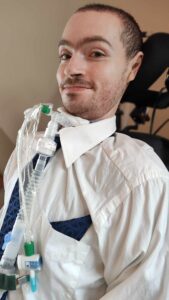
Kareem Azzazi using his ventilator
As an adult, his breathing was stable using full-time noninvasive ventilation, but he decided to have a tracheostomy and switch to invasive ventilation.
“I didn’t want to wait until there’s an emergency,” he says. “I thought, ‘I will eventually get on the trach.’ So, I just mentally prepared myself.”
For people with DMD, sometimes invasive ventilation is needed when a noninvasive ventilation mask cannot deliver enough air, weakness in the swallowing muscles leads to frequent aspiration, or they have a severe illness or injury.
Kareem credits conversations with his family and a friend who was his caregiver for 15 years with helping him think through his options and what he wanted for the future.
He finds it easier to breathe with the tracheostomy, and “things I didn’t think about, like my eating habits, have improved,” he says.
He also thinks the tracheostomy makes it easier to connect with other people. “I used to have nasal tubes always in my nose — like an elephant trunk. People can see my face now,” he says.
Overall, he feels relieved that he made the choice on his own terms. “My mantra is, ‘focus on what you can control,’” he says.
Addressing common fears
Dawn Magid, a social worker at the Barrow Neurological Institute in Arizona, says conversations about ventilation are some of the most difficult for people with neuromuscular diseases and their families. “I think the issues around breathing are one of the most frightening aspects to most people,” she says. “There’s fear about being short of breath and not being able to communicate.”
She recommends talking about respiratory support with your care team early, so you understand the options and how respiratory equipment can help preserve lung function and communication.
Courtney Roberts
Dawn also sometimes addresses the misconception that breathing support will cause the respiratory muscles to weaken faster, leading to dependence on the machine.
Instead, respiratory support reduces strain on weakened muscles, improves comfort, and can help people conserve energy for the activities that matter most. The underlying disease process leads to weaker muscles, not the equipment itself.
“Once people start on noninvasive ventilation, usually they want to increase it more over time because that’s what brings them comfort,” she says.
A common concern about respiratory support is that being tied to a machine will make it hard to leave home.
Courtney Roberts, a respiratory therapist at Helen DeVos Children’s Hospital in Michigan, points out that today’s portable ventilators are smaller, lighter, and easier to move around with. “They have really good battery life,” she says. “It shouldn’t be an issue for patients to go to school or go to work and still do normal daily activities outside of the home. The goal is always to maximize independence, not limit it.”
Addressing common barriers
It takes some time to get used to assisted ventilation, so it’s important to work with your respiratory care team to adjust your ventilation settings and try various interfaces until you find the most comfortable and safest regimen for you.
One of the most common challenges is finding a comfortable mask. For nighttime, there are masks that cover just the nose or the nose and mouth. For daytime, a mouthpiece is also an option, such as sip and puff, which looks like a straw that a person can take a “sip” of air from whenever they need it.
Courtney has samples of different types of masks that patients can try before they order one. At clinic visits, Courtney asks about their experience with their breathing device and helps troubleshoot any problems.
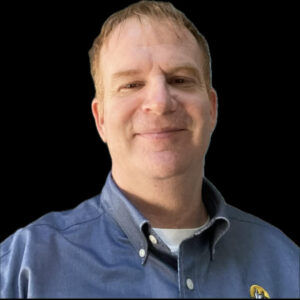
Michael Reeser
“I try to talk to them and see what their barriers are,” she says. “Maybe they’re not able to fall asleep with that air coming from the BiPAP machine into the mask. I can show them different features on the machine, like ramps, where the machine will be at the lowest pressure while they fall asleep, then automatically adjust to their set pressures.”
Respiratory therapists are key members of your care team who can help you with any issues, from adjusting settings to trying different equipment. You may work with a respiratory therapist in your clinic and with a respiratory therapist associated with your DME provider who comes to your home to set up equipment and train you and your caregivers to use it.
Michael Reeser is a Senior Respiratory Therapist with Millennium Respiratory Services, a Florida-based DME and respiratory care company. He visits many of his clients monthly to maintain their equipment and address any issues they’re having.
“I like to consider myself a resource for my patients in their ongoing journey through using the equipment,” he says. “I encourage them to reach out to me if they have questions or need a little bit more support on or off the ventilators.”
He works closely with doctors and clinics to make sure people can get the respiratory equipment they need and use it effectively. “As a respiratory therapist who’s been doing this a long time, I’d say that if the doctor is making a recommendation for a ventilator and you’re on the fence, you know what? Try it,” he says. “Until you try it yourself, you may not have an appreciation for how ventilation support will impact you.”
The post Respiratory Support Makes a Big Difference: Community Perspectives on Using a Ventilator appeared first on Quest | Muscular Dystrophy Association.