


Since her diagnosis with ALS at age 32, Gwen Petersen has poured her energy into advancing the science of her disease through participation in clinical and observational research. Gwen works together with her beloved group, Her ALS Story, to raise awareness that young people can get ALS, too. Gwen is married to her best friend, Nathan, and they are parents of an exuberant Goldendoodle named Annabelle.
In 2018, I was diagnosed with ALS at 32 years old, but my diagnostic journey began some time before. To date, the hardest part of my ride was the 1.5 years I spent bouncing between doctor’s appointments and not being heard. I was listening to my body, but no one was listening to me. It was easier for doctors to call it “anxiety” and prescribe medication, rather than listen to my descriptions of early symptom manifestations, which included imbalance and gait issues. I thought my experiences as the “hysterical woman” were unique to my story.
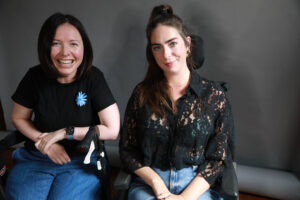
Gwen Petersen with best friend and founder of Her ALS Story, Leah Stavenhagen
Then, in 2021, a mutual friend introduced me to a vibrant woman in her 20’s, living with ALS, who endured her own diagnostic odyssey. There was instant camaraderie; she spoke about not fitting the ALS stereotype, or any terminally ill patient stereotype. We bonded over feeling like the odd-woman-out at support group meetings where the demographic was mostly male, over 50, and service veterans (note: veterans are 2x as likely to be diagnosed with ALS). There had to be more young women like us. With the help of the patient-centric, nonprofit I AM ALS , a call to action was issued on the organization’s website for stories of young women diagnosed with ALS. Within a few months, stories came pouring in, at which time creator and founder Leah Stavenhagen launched Her ALS Story: a global community for women diagnosed with ALS before the age of 35.
With storytelling at its foundation, Her ALS Story was designed (and continues) to be a multichannel communication network where members create connections by openly sharing information, tools, and resources. Some stories are meant only for “the sisterhood” (internal) while others are intended to reach wide audiences. Her ALS Story is so much more than a support group. A big piece of the mission is to pull back the veil on how we manage our day-to-day lives with a terminal illness.
How we create community
Members meet virtually biweekly to connect as a group. Meetings are part informative and part informal support group. Meetings feature a variety of speakers, including mental health professionals, experts in assistive technology, off label/alternative treatments, and ALS researchers.
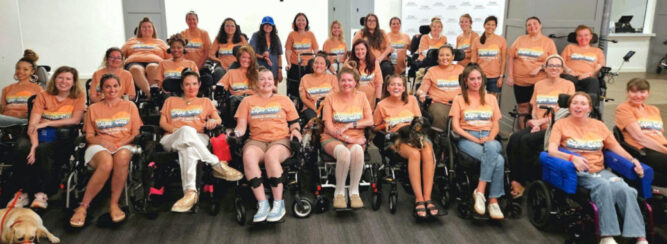
Her ALS Story Members at 2024 Retreat
We have constant connection with each other through a WhatsApp chat so that our members never feel alone. We have subgroup chats for specialized topics such as parenting, feeding tubes, BiPAPs, travel tips, etc. Members swap advice and serve as an outlet. With members across global time zones, there is always someone online. We talk about anything and everything including pillows for sleep, BiPAP mask preferences, relationship issues, grants for out of pocket medical and caregiver costs, etc. No one understands our needs like we do.
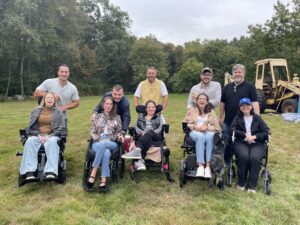
Gwen with Her ALS Story sisters and spouses
In 2022, something truly magical happened. One of our members organized a small in-person “retreat” in her hometown. With the theme of “wellness” in mind, this member leveraged her close ties within the local community, to either donate or provide reduced-cost services including massage, facials, and local excursions. We even had a local chef, who was a close family friend, host a meal in his restaurant. We recognized the power of meeting in real life. Our initial meetup in 2022 inspired our subsequent retreats. This year will mark Her ALS Story’s fifth annual in-person retreat.
Inspired by the annual retreat, members from different regions often organize in-person meet ups. This is on an ad hoc basis. There is unique value in meeting face-to-face. In-person meet ups allow for natural, non-verbal communication that helps us to connect on a more meaningful level.
How we advocate
We educate by sharing our stories. Most people, including medical professionals, are surprised to learn that so many young women have ALS and that we are a diverse group located throughout the globe. ALS can strike anyone at any time of their lives.
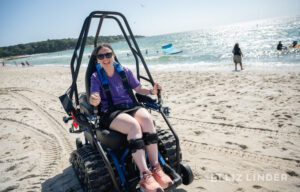
Gwen driving an Action Trackchair at Her ALS Story Retreat 2025
We partner with ALS organizations, like MDA, to advocate for research and legislative change to help patients gain access to safe experimental therapies. Many people living with ALS want to try investigational products that could help with symptom management; however, most do not get the chance. Many ALS patients’ symptoms progress rapidly; as a result, they do not meet standard inclusion criteria and are therefore excluded from participating in traditional clinical trials. Health care providers, ALS organizations, and patients themselves lobby for access to safe experimental therapies through alternative pathways, such as expanded access expanded access.
We create social media campaigns to show what it looks like to be a young woman living with ALS. We give audiences insight into our day-to-day lives. To illustrate this further, we created a blog to share our unique stories and experiences. The blog lives on our website and when there is a new blog entry, we share an excerpt of it on social media.
ALS is extremely underfunded, so we use our stories to get ALS the attention it so desperately needs to end the disease.
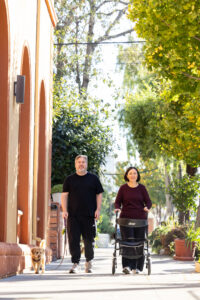
Gwen with Nathan and their dog, Annabelle
We regularly engage with leaders in the research community by attending and speaking at scientific conferences. The scientific community wants to hear from patients about their lived experiences. Engagement between patients and drug developers can lead to the creation of Patient Advisory Boards, which serve as a means of incorporating patient-centric values in study design, data collection, recruitment/retention, and so much more.
We created business cards which we hand out at conferences. For example, at scientific conferences, typically, there is an exhibition hall with commercial and medical booths. Patients can engage 1:1 with industry professionals about pharmaceutical products, medical devices, and assistive technology. Brief introductions have blossomed into bigger opportunities for Her ALS Story, such as sponsor presentations to our larger member base, as well as the chance to demo different products and provide feedback.
We raise awareness across our social media platforms for organizations that are laser focused on ALS research.
We put our tech savvy skills to good use by participating in community webinars where we showcase how we use assistive technology. We also consult with assistive technology industry and non-profit partners to provide product feedback.
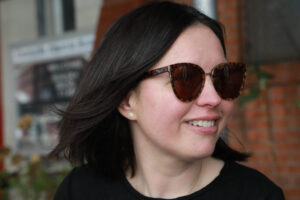
Gwen Petersen
Since 2021, Her ALS Story has grown from 10 U.S. based members to 175 members located across the globe. What I find most inspiring about this group of women is that we’re all different: geographically, culturally, socioeconomically. Things that might otherwise divide feel superfluous. Our priority is human connection in the fight against one of the worst diseases known to (wo)man.
The post MDA Ambassador Guest Blog: How to Find Community for Young People Living with Debilitating Diseases appeared first on Quest | Muscular Dystrophy Association.