


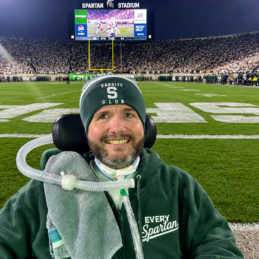
Mo Gerhardt at a Michigan State University football game.
Mo Gerhardt is changing the game when it comes to accessible and inclusive fashion. The 48-year-old retired Michigan State University (MSU) Academic Advisor and Women’s Basketball Academic Coordinator, who lives with LGMD 2D, has found passion and purpose in his second chapter through the creation of Every Spartan . Every Spartan is a first-of-its-kind clothing line that designs and provides branded adaptive apparel side-by-side with traditional apparel. The MSU-licensed apparel brand is rooted in inclusion, accessibility, and storytelling – offering all students, faculty, families, and fans access to the same fan experience.
“As someone living with muscular dystrophy and using a wheelchair, I’ve always been aware of how limited representation can be, especially in areas like apparel and fan experiences,” Mo says. “What makes this brand different is that we design traditional and adaptive apparel side by side—not as separate categories, but as part of the same collection. The goal is simple: to ensure that people of all abilities feel equally represented.”
Now, the brand has evolved and expanded to become Every Collegiate and is bringing that inclusive model to colleges across the country.
Finding inspiration in a new chapter
Initially diagnosed with Duchenne muscular dystrophy (DMD) in the 1980s, Mo didn’t receive his accurate diagnosis of LGMD 2D until genetic testing in 2000. He attended MSU in the late 1990s to study business at a time when it was uncommon for someone using a wheelchair and living with muscular dystrophy to attend college full-time. While at MSU, he discovered and embraced a powerful sense of community that would prove to be integral in the trajectory of his life.
After graduating both undergrad and graduate school at MSU, he chose to stay within the community that he had come to love so much, working for the university for more than 15 years. His path changed dramatically when he was hospitalized for respiratory failure in 2019. After five months in the hospital, he was discharged with a tracheostomy and ventilator. Complications of his care resulted in the loss of ability to speak for two years.
“That period changed everything,” Mo says. “But it also reshaped how I think about identity, visibility, and what it means to be included.”
Having used a wheelchair for the majority of his life, Mo was familiar with the reality that accessible clothing options were limited and often felt institutional. After getting his tracheotomy, he began to look at clothing even more differently because collars and necklines often interfered with access to his tracheotomy. He paid a seamstress to alter his clothing so that he could wear it safely and comfortably, all the while becoming more aware of a problem that he could not ignore.
“People with disabilities shouldn’t have to choose between clothing that works and clothing that they actually want to wear,” he says. “The available adaptive clothing options that I looked at all seemed dated, lacked recognizable logos, never had any team branding. They were not clothes that I wanted to wear, and they didn’t really allow me to express identity or school pride.”
As an active member of the MSU community for decades, Mo recognized that the ability to express school pride and experience the same sense of belonging and identity that able-bodied students, faculty, and family had access to was an important missing piece in the disability community. “Many people develop a lifelong connection with their school, teams, traditions, and fans – that is often shared across entire families,” Mo says. “When you think of something as simple as a family holiday card where everyone wants to wear the same logo or team design, a person with a disability should be able to wear what everyone else in the family is wearing. Or be in the stands cheering for their team wearing what everyone else is wearing. In many ways it may sound like a small moment, but it’s not small at all. It is the difference between being included and simply being accommodated.”
That differentiation inspired the creation of Every Spartan, an endeavor that also provided Mo with new purpose after his medical retirement.
The need for a new model
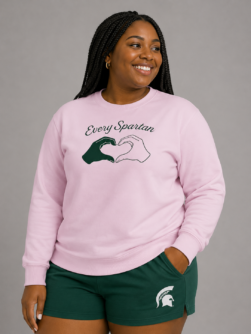
Every Spartan apparel.
“My mission was really to create an inclusive apparel brand, because that distinction really matters to me. Adaptive apparel separated into its own brand tells people with disabilities that they are being treated as an afterthought. Instead, it needs to be presented side-by-side with traditional clothing. The same logo and same designs and same quality so that everyone can share that same sense of pride,” Mo says. “Separate but equal is anything but equal. True inclusion doesn’t create a different experience but makes sure that we are part of the same experience from the beginning. A person’s disability should never limit a person’s ability to participate in their personal identity, family identity, and school identity. Inclusive design says you belong here too.”
With his degrees in business and accounting, Mo already had the education foundation of how businesses operate. But he, admittedly, lacked expertise regarding the apparel industry specifically. As he embarked on learning an entirely new field while building the brand itself, Mo developed his mission, created the brand identity, learned how to protect trademarks and navigate university licensing and laws, found a production facility to create both traditional and adaptive apparel, and built his own website.
“It took a tremendous amount of research and relationship building, a lot of trial and error, and rejections. But continued persistence has been a trademark of my whole life in a lot of ways,” Mo says. “Obviously there is the difficulty of living with physical limitations that come along with muscular dystrophy and facing the reality that the way that I work is going to look different. But the ideas and decisions and leadership are no less. Every Spartan allowed me to turn that concept into Every Collegiate and really take that idea and build a national company around it. I am not interested in just adding a few adaptive products to the market – I want to disrupt the fashion and athletic apparel industry by changing the way people think and see accessibility, representation, and who the clothes are designed for.”
Based on his own loyalty and role within the MSU community, starting with MSU to create his brand was the natural choice for Mo. This year, Every Spartan became the first licensed NCAA apparel brand to offer both traditional and adaptive apparel side by side. The line includes garments featuring easier closures using magnets or Velcro to make openings more accessible, designs made to reduce the difficulty of overhead dressing, and construction to better accommodate seated wear and dressing with assistance.
“Our philosophy is to create designs that make dressing easier, more comfortable, and more dignified,” Mo says. “Everyone has different needs and there is not one single solution that fits everyone, but the goal is to provide the thoughtfulness behind the choices while maintaining that same official school identity and sense of pride through apparel. Adaptive shouldn’t require someone to sacrifice quality and authenticity. The connection between the features in the garments across the brand means that the adaptive version looks as traditional as possible and anyone else looking at someone wearing it shouldn’t know that it was adapted.”
Expanding and increasing inclusion across the country
In Mo’s opinion and experience, clothing is much more than what we wear. In many ways it communicates who we are: what we believe in, where we belong, and the different communities that matter to us. With majority of accessible clothing focused on function over style or self-expression, Mo is committed to making an impact on the universal need for access to brands that offer style, identity, and belonging beyond accessibility.
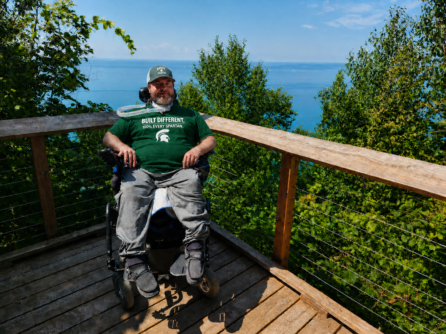
Mo wearing Every Spartan apparel.
“We want to be able to support our teams and wear recognizable brands and participate in the same traditions as everyone else. When we don’t see ourselves represented, the message is that we really aren’t being considered,” Mo says. “Accessibility addresses practical barriers. Inclusion, to me, is the biggest part of that sense of belonging that allows people with disabilities to be seen as complete, rather than limited or reduced to a diagnosis. I don’t want disability representation to only exist in medical stores or catalogs. We are students and alumni. We are athletes. We are parents, professionals, consumers, fans. Everything.”
And colleges across the country are taking notice. One of the most validating developments while building his brand was when multiple universities began reaching out to Mo personally to say that they want to be part of this collection. Mo is currently working closely with multiple big-name universities to navigate licensing and develop branding as Every Spartan evolves to Every Collegiate Apparel. He recently officially announced the addition of both Arizona State University, Miami University, and Towson University to the Every Collegiate Apparel collection.
Every Collegiate Apparel has also garnered the attention of GAMUT, an international leading authority when it comes to adaptive apparel, who recently awarded Every Collegiate Apparel with an exclusive GAMUT certification in the collegiate licensed apparel space. As he works through the process of bringing inclusive design to campuses across the country, Mo’s evolving mission is evident in the update of his company’s motto from “Every ability, every moment, every Spartan” to “Every ability, every moment, every school”.
The post Every Collegiate™ Apparel Brings Inclusion to Campus appeared first on Quest | Muscular Dystrophy Association.