


Last Friday, my girlfriend, Amanda Yip, and I celebrated the second year of Rebirth Ensemble, the disability-led creative business we founded in Singapore in October 2024.
We began with an ambition: to make art more accessible. Now, we’re exploring creative storytelling, multisensory art, and accessibility consultancy. Yet the biggest change hasn’t been our business path; it’s how I understand my contributions while living with Duchenne muscular dystrophy (DMD).
DMD progressively weakens my muscles. I use a manual wheelchair, rely on noninvasive ventilation around the clock, and need assistance from caregivers throughout the day. Those realities shape how I work and how my ambitions develop.

Finding new ways to create
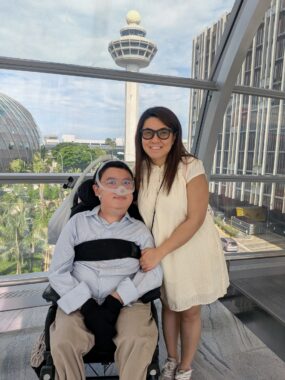
Shalom Lim and Amanda Yip founded Rebirth Ensemble in October 2024. (Courtesy of Shalom Lim)
Art has been important to me since childhood. My late brother, Isaac, who also had DMD, and I once used our paintings to raise funds for Singapore’s muscular dystrophy community. I can no longer paint independently, and I certainly miss it.
Starting Rebirth Ensemble with Amanda, who lives with progressive vision loss, gave me another way to stay involved and use my creative talents. Our tactile art projects brought together our experiences navigating limited vision and mobility barriers.
Gradually, we began asking whether those perspectives could help improve experiences beyond galleries and workshops.
Learning through entrepreneurship
I’ve written before about how DMD informs my understanding of accessible design. Two years of entrepreneurship have taught me something different: Recognizing a problem isn’t the same as building a viable solution.
Amanda and I must learn what clients need, explain our ideas, and work toward financial sustainability. We’re figuring things out as we go. Sometimes progress is slower than we had hoped, and not every idea becomes a workable project.
We’ve also learned that our experiences can’t speak for everyone with disabilities. Listening to others and collaborating across perspectives are essential if our work is to be useful.
Growing alongside Duchenne
Meanwhile, DMD doesn’t pause for business plans. Medical appointments, fatigue, transport arrangements, and caregiving needs still shape my schedule. Sometimes preparing for a meeting takes more effort than the meeting itself.
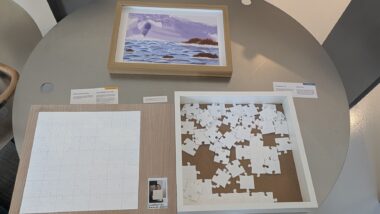
“(Invisible) Puzzle” is a tactile art collaboration between Rebirth Ensemble co-founder Amanda Yip and designer Edmund Zhang. Above that on the table is a painting by Amanda titled “Serenity.” (Courtesy of Shalom Lim)
I don’t see entrepreneurship as a way to overcome those difficulties. Nor does it replace the satisfaction I once found in painting. Instead, it has opened another door for me to contribute through ideas, storytelling, and collaboration.
As we enter our third year, I can’t promise where Rebirth Ensemble will go. But I’m glad Amanda and I took a chance and started it. My physical abilities have changed, and my understanding of what meaningful work can look like is changing, too.
Note: Muscular Dystrophy News is strictly a news and information website about the disease. It does not provide medical advice, diagnosis, or treatment. This content is not intended to be a substitute for professional medical advice, diagnosis, or treatment. Always seek the advice of your physician or another qualified health provider with any questions you may have regarding a medical condition. Never disregard professional medical advice or delay in seeking it because of something you have read on this website. The opinions expressed in this column are not those of Muscular Dystrophy News or its parent company, Bionews, and are intended to spark discussion about issues pertaining to muscular dystrophy.
The post Pursuing meaningful work while living with Duchenne muscular dystrophy appeared first on Muscular Dystrophy News.