


In recognition of Muscular Dystrophy Awareness Month in September, the Muscular Dystrophy Awareness Month campaign features a series of stories highlighting the real-life experiences of people affected by muscular dystrophy, written in their own words. Follow us on Facebook, Instagram, or X for more stories like this, using the hashtag #MDAwarenessMonth, or read the full series.
When muscular dystrophy enters a family, it’s not just a diagnosis or a medical challenge. It changes how parents imagine the future, how siblings understand resilience, and how ordinary milestones are measured. In our family, facioscapulohumeral muscular dystrophy (FSHD) has brought worry, uncertainty, and practical burdens — but it has also revealed extraordinary strength, purpose, and love.
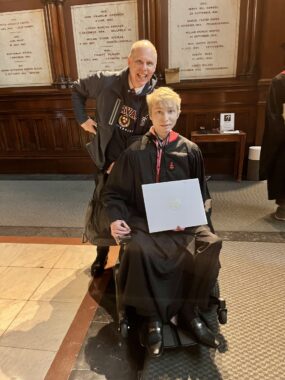
Raymond Huml accompanies his son, Jon, on Jon’s graduation day at Harvard University.
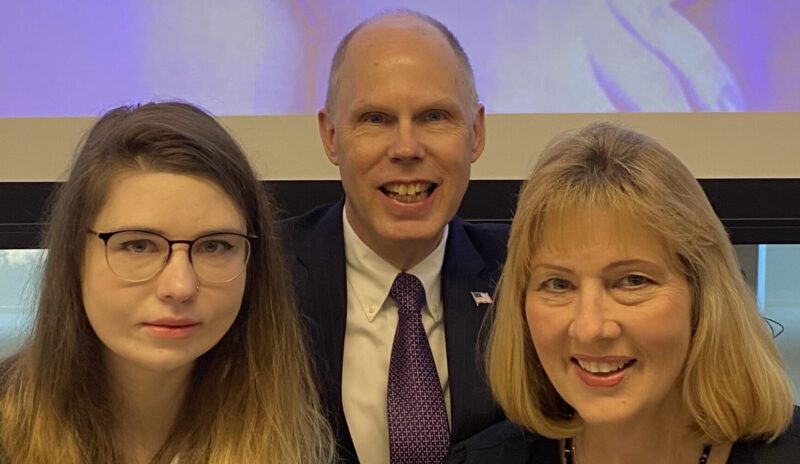
I am a veterinarian by training and a rare disease biopharmaceutical industry professional, but my deepest connection to muscular dystrophy is personal. I am the father of two adult children living with FSHD. In professional settings — on LinkedIn, in talks, and in thought leadership pieces — I often share the milestones that fill me with pride.
My son, Jon, became an Eagle Scout without accommodations, graduated from Harvard and Columbia universities, and now publishes in computational neuroscience. My daughter, Meredith, founded the North Carolina chapter of the FSHD Society, creating a local source of connection, advocacy, and hope for families like ours. She also helped me write two Springer books: one on muscular dystrophies and one on rare disease drug development. These accomplishments are real, and they matter.
But they are only part of the story. What is harder to capture in a brief biography is the emotional weight FSHD places on an entire family: the uncertainty of living without an approved disease-modifying treatment, the mental health toll of watching loved ones adapt to a progressive condition, and the practical strain of navigating medical and support costs while falling between systems of help — too financially secure to qualify for some programs, yet not secure enough to absorb every expense easily.
FSHD has taught us that resilience is not a slogan. It is a daily practice, asking difficult questions, showing up for appointments, adapting plans, celebrating progress, and continuing to advocate, even when answers come slowly. Our family keeps looking for hope wherever we can find it — in research, community, connection, and the determination of people living with this disease.
Professionally, I work to streamline drug development and keep the patient voice at the center of rare disease innovation. Personally, I carry that mission as a father who wants a better future for his children and for every family affected by FSHD.
The post Carrying hope forward with resilience in an FSHD family appeared first on Muscular Dystrophy News.