


On Thursday, February 26, advocates, clinicians, patient leaders, and policymakers came together for a powerful Senate Special Committee on Aging hearing titled “From Regulator to Roadblock: How FDA Bureaucracy Stifles Innovation.” This conversation served as a reminder of how far the muscular dystrophy and rare disease community has come, and the work still to be done.
25 Years After the MD-CARE Act’s First Hearing
One day short of 25 years ago, on February 27, 2001, the muscular dystrophy community stood in that same Senate hearing room and made history with a hearing that catalyzed the passage of the Muscular Dystrophy Community Assistance, Research and Education (MD-CARE) Act, a law that fundamentally reshaped federal investment in Duchenne and other muscular dystrophies. This landmark moment amplified patient voice, changed policy, and set a model for how patient communities could partner with Congress to advance progress.
 Today, rare disease advocates once again gathered in SH-216 to debate how the current regulatory system impacts patient access to innovation, including novel and life-altering therapies that families affected by Duchenne and Becker are waiting for.
Why This Hearing Matters to the Duchenne and Becker Community
The focus of today’s hearing centered on how the Food and Drug Administration (FDA)’s regulatory processes — including evolving standards, shifting expectations, and bureaucratic hurdles — can unintentionally delay or complicate patient access to safe and effective treatments, especially in rare disease. Members of the Senate Aging Committee explored how greater clarity, predictability, and patient-centered reforms could help the U.S. stay at the forefront of biomedical innovation.
For families affected by Duchenne and Becker, this is about accelerating the path to new therapies, reducing uncertainty in drug development, and ensuring that regulatory systems fully integrate the patient perspective into decision-making and review standards.
Spotlight: EveryLife Foundation for Rare Diseases’ Annie Kennedy
Among the hearing’s distinguished witnesses was Annie Kennedy, Chief Mission Officer of the EveryLife Foundation for Rare Diseases and long-time fierce Duchenne and Becker advocate. Her testimony brought critical rare disease expertise to the hearing and underscored a central reality: regulatory complexity disproportionately impacts small patient communities working urgently to advance therapies. She also highlighted the tangible opportunities for thoughtful reforms that can accelerate progress across the rare disease ecosystem — including for families affected by Duchenne and Becker.
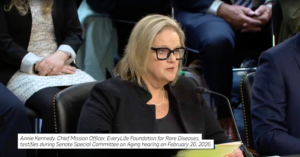
The EveryLife Foundation has been a national leader in strengthening FDA engagement with rare disease stakeholders and advancing more transparent, consistent regulatory approaches that provide greater predictability in development pathways. PPMD is proud to partner with EveryLife in advancing policies that foster scientific innovation while ensuring patients remain at the center of regulatory decision-making.
Looking Forward
The 2001 MD-CARE Act hearing demonstrated the power of coordinated advocacy to spur federal action on Duchenne muscular dystrophy. Today’s hearing reminds us that policy engagement remains a critical piece of progress, and that patient voices must be heard not only in Congress, but throughout the entire regulatory lifecycle. It is because of our community’s shared voices that today’s therapeutic landscape is robust and growing, and that individuals affected by Duchenne and Becker are living longer, stronger lives than ever before.
As discussions around regulatory reform continue, we must stay engaged, vigilant, and united in advocating for systems that prioritize patients, reward innovation, and get transformative therapies into the hands of those who need them most.
We are grateful to the hearing witnesses for sharing their expertise and lived experience, and to our congressional champions for continuing to elevate the needs of the Duchenne and Becker community. We look forward to building on this momentum at our upcoming Advocacy Conference, where advocates from across the country will come together to advance policies that strengthen research, access, and care.
The post 25 Years Later: Reflecting on the 2001 MD-CARE Act Hearing and Where We Are Now appeared first on Parent Project Muscular Dystrophy.