



Boys with Duchenne muscular dystrophy (DMD) who received Sarepta Therapeutics’ gene therapy Elevidys (delandistrogene moxeparvovec-rokl) in a clinical trial continue to show signs of slowed disease progression relative to DMD’s natural course, along with caregiver-reported improvements in everyday living.
That’s according to data from the Phase 3 EMBARK clinical trial (NCT05096221) presented at the 2026 Muscular Dystrophy Association (MDA) Clinical & Scientific Conference, held March 8-11 in Orlando, Florida, and online.
“The body of evidence for Elevidys continues to grow,” Louise Rodino-Klapac, PhD, president, research and development and technical operations at Sarepta, told Muscular Dystrophy News Today in an interview at the MDA meeting. “With over 1,200 patients [dosed], we obviously have the largest group of patients treated with a gene therapy. And we’ll continue to collect data on all outcomes … and follow them.”
The company is also testing ways to prevent liver damage after the gene therapy, which has been a concern since Sarepta reported death due to liver failure for two boys unable to walk (nonambulatory) who received Elevidys.
The deaths prompted U.S. regulators to revoke the therapy’s conditional approval for nonambulatory patients, which it had earned in 2024.

Positive trial data could allow resumed dosing
The ongoing ENDEAVOR clinical trial (NCT04626674) is now enrolling about 25 non-ambulatory DMD patients in the U.S. It will test whether treatment with the immunosuppressant sirolimus before and after an Elevidys infusion can prevent liver damage.
With positive data from this trial, Sarepta “can potentially resume dosing in that population,” Rodino-Klapac said.
People with DMD lack the muscle-protecting protein dystrophin due to mutations in the DMD gene, leading to muscle weakness and wasting, heart problems, and other MD symptoms.
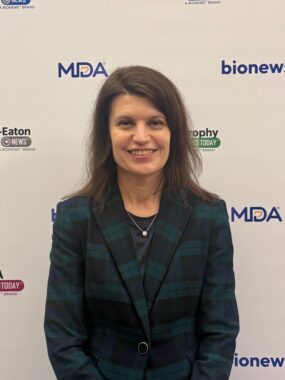
Louise Rodino-Klapac, PhD, president of R&D at Sarepta Therapeutics, attended the MDA 2026 conference. (Photo by Kellie Benn)
Elevidys is a one-time gene therapy designed to deliver a version of DMD that enables a patient’s cells to produce a shortened, but functional, dystrophin protein. The genetic material is packed up into a viral carrier (vector) that helps it be taken up by cells, particularly in the heart and skeletal muscles.
The treatment is approved in the U.S. for DMD patients ages 4 and older who are able to walk (ambulatory).
In the first part of EMBARK, ambulatory boys with DMD, ages 4-7, received a single infusion into the bloodstream of Elevidys or a placebo. In the second part, participants who had previously received the placebo were given Elevidys.
In a talk titled, “Delandistrogene Moxeparvovec in Duchenne Muscular Dystrophy: Functional and Safety Outcomes up to 3 Years Post-Infusion in the EMBARK Study,” trial investigator Craig McDonald, MD, of the University of California, Davis, discussed three-year functional data from participants who received Elevidys in the study’s first part.
Boys given Elevidys outperformed an external group of untreated boys with DMD across a range of functional measures, with the differences being clinically meaningful and statistically significant.
In the North Star Ambulatory Assessment (NSAA), a global measure of physical function, Elevidys-treated boys maintained relatively stable function at year 3, while the external control group declined substantially, with a difference of more than 4 points.
While NSAA is good for assessing broader, long-term changes, scientists have come to understand it’s not as sensitive for detecting early functional changes in children who are still in a relatively stable disease stage.
Data from timed function tests, which evaluate how quickly a person can perform activities such as standing from the floor or walking a certain distance, are more sensitive to that. These tests also showed meaningful improvements for children given Elevidys relative to the control group after three years.
“You want to look at everything together, really, to get the totality of evidence for a drug,” Rodino-Klapac said.

Anecdotal evidence from daily life
In terms more relatable to patients and families, these differences in functional scores might mean that these children “can continue to do activities of daily life, like get off the floor,” Rodino-Klapac said. “We also hear things anecdotally, like better endurance throughout the day.”
Rodino-Klapac said the differences in function between treated and untreated boys have grown from year to year.
“Over one, two, and three years, as the … external control counterparts naturally decline, you see the gap between treated and untreated continue to grow,” she said, noting that this is in line with Elevidys’ goal of slowing or stabilizing long-term disease progression.
These gains are particularly exciting in light of the fact that trial participants are, on average, now almost 9, an age at which people with DMD are “typically rapidly declining,” she said.
The three-year data overall “is really telling to the long-term durability of Elevidys,” Rodino-Klapac said. “And we expect that to continue to grow over time.” She pointed to long-term data from an earlier Elevidys clinical trial showing that children have maintained functional stability for five years after the infusion.
Stable disease is a very meaningful outcome for a progressive condition like DMD, according to Rodino-Klapac. When patients aren’t getting worse, “that just prolongs any milestones, like losing ambulation and [lung function] down the line,” she said.
The EMBARK study also included caregiver-reported outcome measures, discussed in a poster titled, “Caregiver Global Impressions of Delandistrogene Moxeparvovec in Participants with Duchenne Muscular Dystrophy: Findings from EMBARK 2-year Follow-up.”
Such tests can help contextualize how a therapy is actually benefitting patients and caregivers in their everyday lives, according to Rodino-Klapac.
“As we talk to caregivers and patients themselves, they see these measures like the [NSAA], and they say, well, that doesn’t mean anything to me … Can I use my cellphone? Can I feed myself? Can I continue to get off the floor myself?” she said. “Having their impressions of whether they’ve improved is really important for how they function daily.”
Around 79%-87% of caregivers of children treated in part 1 reported improvements in their child’s DMD symptoms, physical abilities, daily activities, and overall health after the first year, which were sustained in year 2.
For participants initially given a placebo who received Elevidys a year later than those in part 1, similar improvements were observed a year after treatment.
According to Rodino-Klapac, that is a particularly important piece of data because it suggests that “regardless of when they’re treated, there will be benefit.” However, she noted that the advice is still to treat patients as early as possible to maximize muscle preservation.
”I think that it’s important to the community that we continue to strive for the populations that are still left untreated.”
In another poster at the MDA meeting, scientists discussed pooled safety findings from across Elevidys clinical trials. It was titled, “Pooled Safety Analysis from Phase 1 to Phase 3 Clinical Trials of Delandistrogene Moxeparvovec in Duchenne Muscular Dystrophy.”
Most treatment-related adverse events occurred within three months of the infusion and resolved on their own or with treatment. The most common ones were nausea, vomiting, and decreased appetite.
With accumulating clinical experience, doctors are well prepared for the side effects that could occur and when they’re likely to happen. “Those are to be expected now, and physicians know how to help treat those,” Rodino-Klapac said.
In the safety analysis, the most common serious treatment-related adverse event was liver injury, seen in 5.5% of 236 patients.
Rodino-Klapac said this happens because the gene therapy’s viral vector reaches the liver, where the immune system recognizes it as foreign and attacks it. That leads to a rise in liver enzymes, a precursor to more serious liver harm.
For this reason, all patients who receive Elevidys also receive a course of corticosteroids, a class of immune-suppressing medications, starting before the infusion and continuing for some time afterward.
Elevations in liver enzymes usually occur within the first few months and most of the time resolve on their own without any problems. But on occasion, things become more serious.
When asked how the DMD community responded to the liver-related deaths reported last year, Rodino-Klapac said: “It was devastating for all, and … there was initially a concern, and rightly so.”
But with the deaths came education, and an “understanding that … these two very devastating deaths occurred in non-ambulatory patients with more advanced disease, and that there are ways to potentially mitigate that,” she added.
Among the possible strategies is using sirolimus, an oral immunosuppressant that’s commonly used to prevent immune-mediated organ rejection after transplants.
The new group of nonambulatory ENDEAVOR participants will start receiving sirolimus 10-14 days before receiving Elevidys and will stay on it for about three months after the gene therapy infusion. The main goals are to monitor for signs of liver injury and changes in dystrophin levels.
Rodino-Klapac said that if results from ENDEAVOR are positive, Sarepta will take the data to regulators to discuss adding the nonambulatory population back to the Elevidys prescribing label.
Since initial approval, Sarepta has continued to collect Elevidys data with the goal of serving as many DMD patients as possible, including non-ambulatory patients and those with antibodies against the viral vector that currently exclude them from treatment.
“I think that it’s important to the community that we continue to strive for the populations that are still left untreated,” Rodino-Klapac said. “So we are continuing to serve this population as best we can.”
Note: The Muscular Dystrophy News Today team is providing live coverage of the 2026 MDA Clinical & Scientific Conference March 8-11 in Orlando, Florida. Go here to see the latest stories from the conference.
The post MDA 2026: ‘Body of evidence for Elevidys continues to grow’ appeared first on Muscular Dystrophy News.